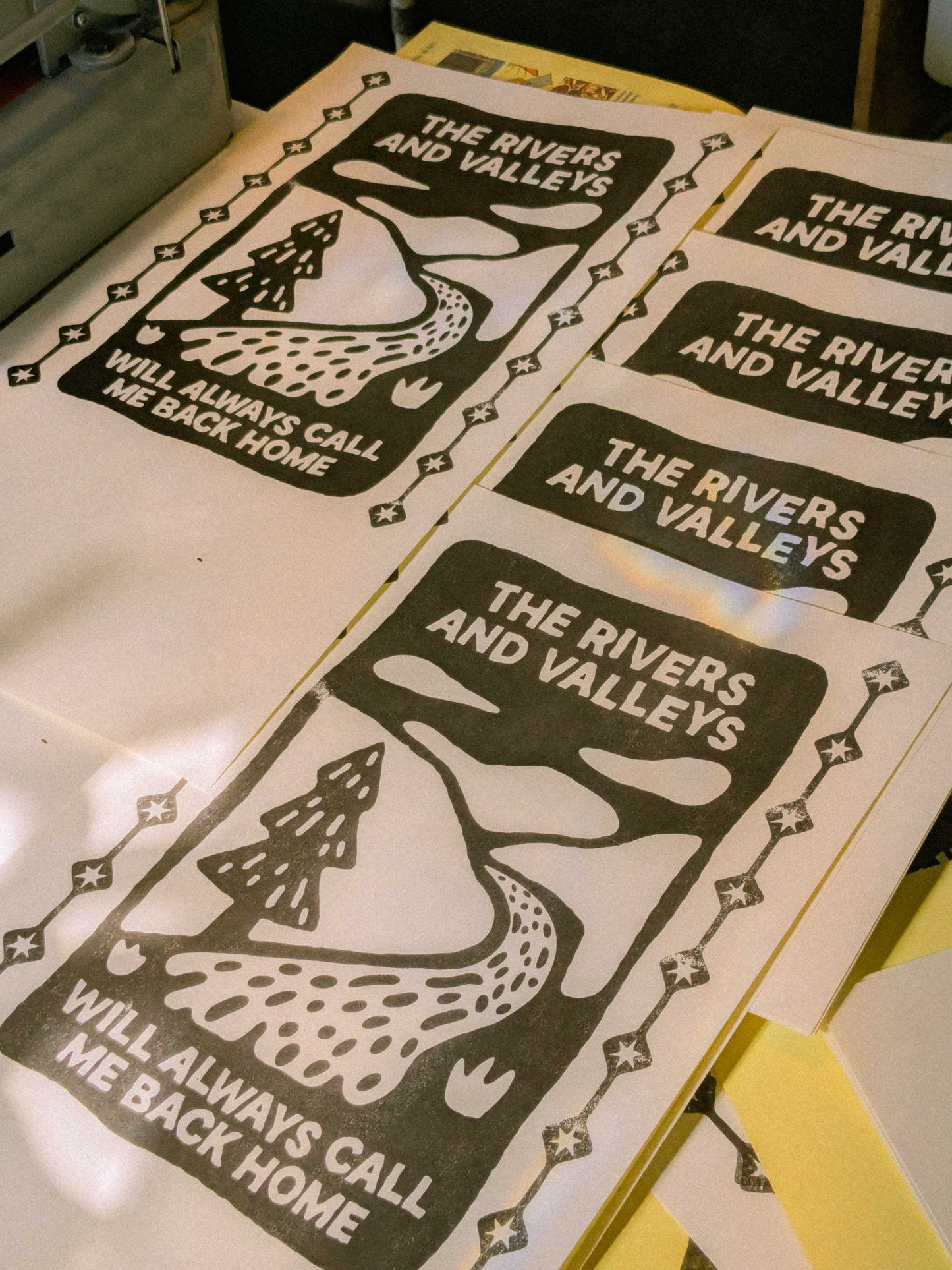
Sometimes an idea will tap you on the shoulder, sit you down, and tell you they have been waiting a long time. These Valleys and Rivers Will Always Call Me Home is one of those for me. It is a print that grew out of childhood memory, quiet nostalgia, and the kind of place you never fully leave, even after you no longer live there.
I was born in Wyoming, but by grade school we had moved south of Springfield, Missouri, to be closer to where my dad grew up. My childhood home sits exactly where the James and Finley rivers meet. It is the kind of meeting place that has always drawn people in. The Mollyjoggers used to hold their camps there, and long before that it was land rich with Indigenous history. Today, where the two valleys come together, you will find a handful of homes and some farmland, but the bones of the place remain the same.
Every morning I would look out over the valleys and watch those two rivers run toward each other, unless the fog was sitting heavy on the water. It was beautiful, but like most people living inside a postcard, I grew used to it and I still take it for granted more than I should. Distance has a way of sharpening memory, and while that place is no longer my physical home, it will always be a home in my heart. I know I am not alone in that feeling. I think that many of us carry our past landscapes inside us to become the backdrop of who we are.
Ideas for artwork come easy to me, the execution is always a bit more of a struggle. I think partially because I know exactly what I want the end result to be but never know quite the path to take to get there.
I have always loved oil pastels and the way they drag across paper, leaving behind thick texture and soft edges. I started the piece with rough pastel sketches, trying to capture the shapes of the hills, the curve of the river, and the quiet of the valley. I love pastels and I love the simplicity of block printing. I know that while the two are separate mediums there is a strong middle ground. So, I stripped the drawing down to its simplest forms. Hills, valleys, river, foliage all reduced to their most essential shapes, the kind of visual language that still feels familiar even without the details.
Since the pastel drawing would not scan cleanly into the risograph, I brought it into my computer, refined the lines, and finished the design in Adobe Illustrator. This also let me place the text exactly where it felt the most honest and grounded. Once everything was cleaned up and ready, I printed the scans for the risograph.
This was a straightforward single color print, but I had a new tool to play with an RZ390 that I picked up a week ago in Fort Smith, Arkansas. The perk of this machine is that it can print at ledger size in a single pass. I trimmed my paper down to 11 by 17 and ran the first pass. The print looked good, but I knew I could push it a bit further. I ran every sheet through again, leaning into that over inked hand press look. Since no print ever travels through a risograph exactly the same way twice, the second pass added soft shifts, heavier shadows, and a natural variation that made each piece feel a little more alive. Once everything dried, I trimmed the stack down to its final 11 by 14 inch size.
This print means a lot to me. It is a small meditation on home, on the places that shape us, and on the rivers and valleys we keep returning to in our memories. I hope it resonates with anyone who has ever loved a landscape, left it, and still feels its pull. Even when we move on, some places stay with us. And that is a kind of home too.